
Taking Home Gold
Gold and the Lunar New Year: Bringing Tradition into Contemporary Homes
The Lunar New Year brings gold into view like no other time of the year. Mall counters, advertisements, and seasonal decorations, all linking the metal to prosperity and good fortune. The association is centuries old, and in East Asian interiors, gold functions as symbolism: a promise to attract abundance.
But historically, homes in China and Japan have used gold for more than symbolic value. Gold altered light, created depth, and established presence. It appeared through surfaces: screens, architectural elements, and paintings that shifted as the day progressed. Contemporary artists continue this practice, working with gold leaf to produce pieces that perform the same role in modern interiors that folding screens once did in castle residences.
The Year of the Fire Horse offers a moment to reconsider this approach. Gold can be something you display, or it can be something that actively shapes your environment. Understanding what gold has historically done in East Asian homes clarifies what it can offer today.

Kinkaku-ji, the Golden Pavilion in Kyoto
Imperial Radiance and Cosmic Order
In China, gold's association with authority traces back to early imperial culture. By the Tang dynasty, gold had become aligned with courtly splendour and cosmopolitan exchange. Gold operated within a visual economy of permanence, objects meant to endure, to signal status not just in life but into the afterlife.
The yellow glazed roof tiles of the Forbidden City created a chromatic field visible across distance. Yellow, linked to the earth element and centrality in the Five Phases system, reinforced the emperor's position at the axis of the cosmos. Gold was part of a broader symbolic order where colour, material, and spatial arrangement worked together.
The roofs of the forbidden city
In Buddhist art, gilding transformed sculpture. Gold leaf heightened transcendence, the reflective surface dissolving contour and emphasising radiance. Gold became metaphysical claim, material made to embody light.
Light, Space, and Domestic Prosperity
Gold entered Japan through continental exchange, but its evolution developed distinct spatial and aesthetic qualities. Early Buddhist architecture used gold to convey sanctity. The Golden Hall at Chūson-ji and the gold leaf exterior of Kinkaku-ji render architecture into reflective form, shifting with weather and time of day.
Birds and Flowers of the Four Seasons, Momoyama Period
By the 16th century during the Momoyama period [1], gold leaf screens transformed interior space in castles and residences. In dimly lit rooms, gold amplified available light while flattening pictorial depth. Landscapes floated against luminous planes. Gold was infrastructure that changed the quality of light and therefore the quality of daily life.
Material as Philosophy: Kintsugi and Continuity
Kintsugi presents a different articulation of gold's function. Gold is applied to repair fractured ceramics, tracing breakage with visible seams. The repaired object does not conceal damage; it formalises it. The line of gold reframes rupture as compositional element.
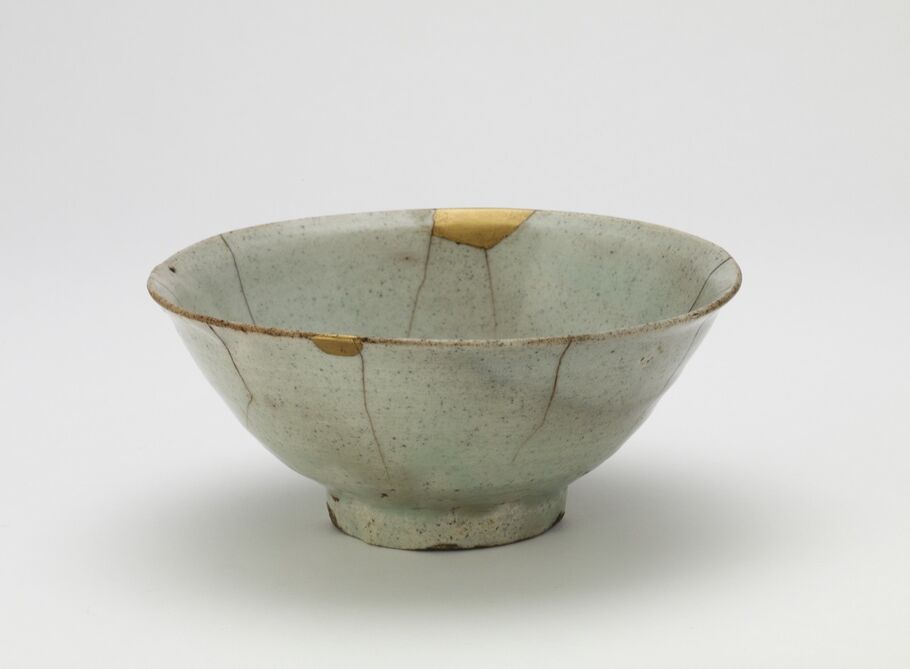
A bowl which has undergone Kintsugi
Here, gold shifts from imperial authority to material philosophy. It participates in an aesthetic attentive to impermanence and transformation, related to the Japanese philosophy of wabi-sabi. The bowl continues to function, the crack remains visible, and gold mediates between the two states.
For contemporary homes, this offers a model. Gold need not signal wealth in the traditional sense. It can signal resilience, the ability to hold contradictions, to make visible the process of repair rather than hiding it.
Chinese New Year and the Huat Mentality
The Year of the Fire Horse brings particular resonance to questions of momentum and vitality. The Horse symbolises enthusiasm, speed, and perseverance. During Chinese New Year, the language shifts to 'huat', the Hokkien term for prosperity that carries connotations of abundance and upward momentum.
Gold's resistance to corrosion makes it a material that endures. Its reflective surface catches light, creating an active presence within domestic space. To bring gold into the home during the New Year period is to invite these associations: permanence, radiance, authority.
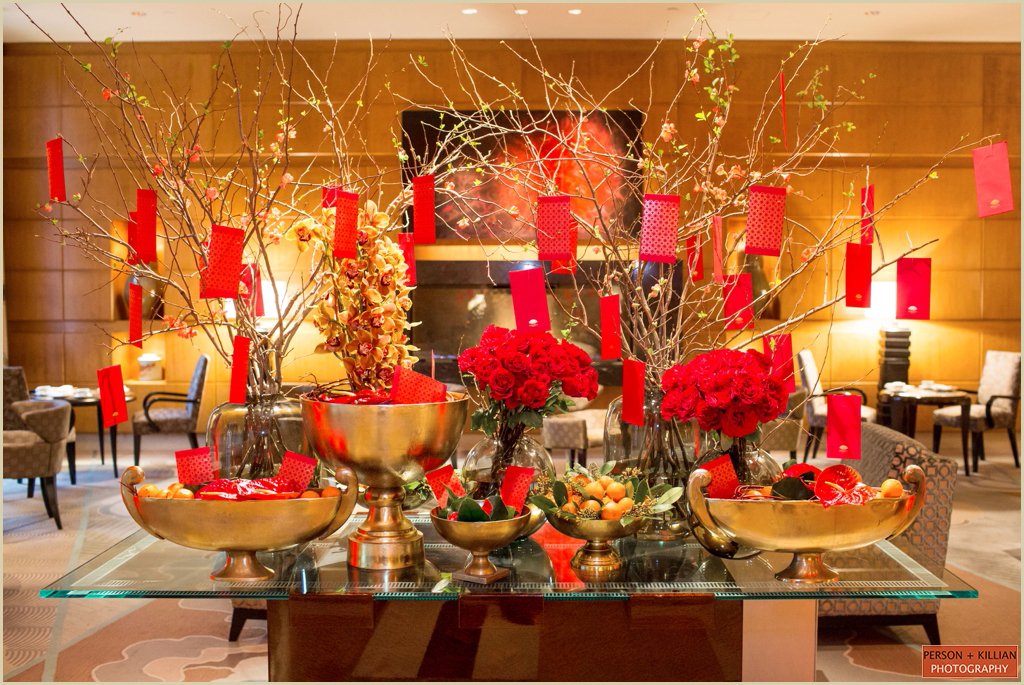
Gold in Contemporary Art and Interiors
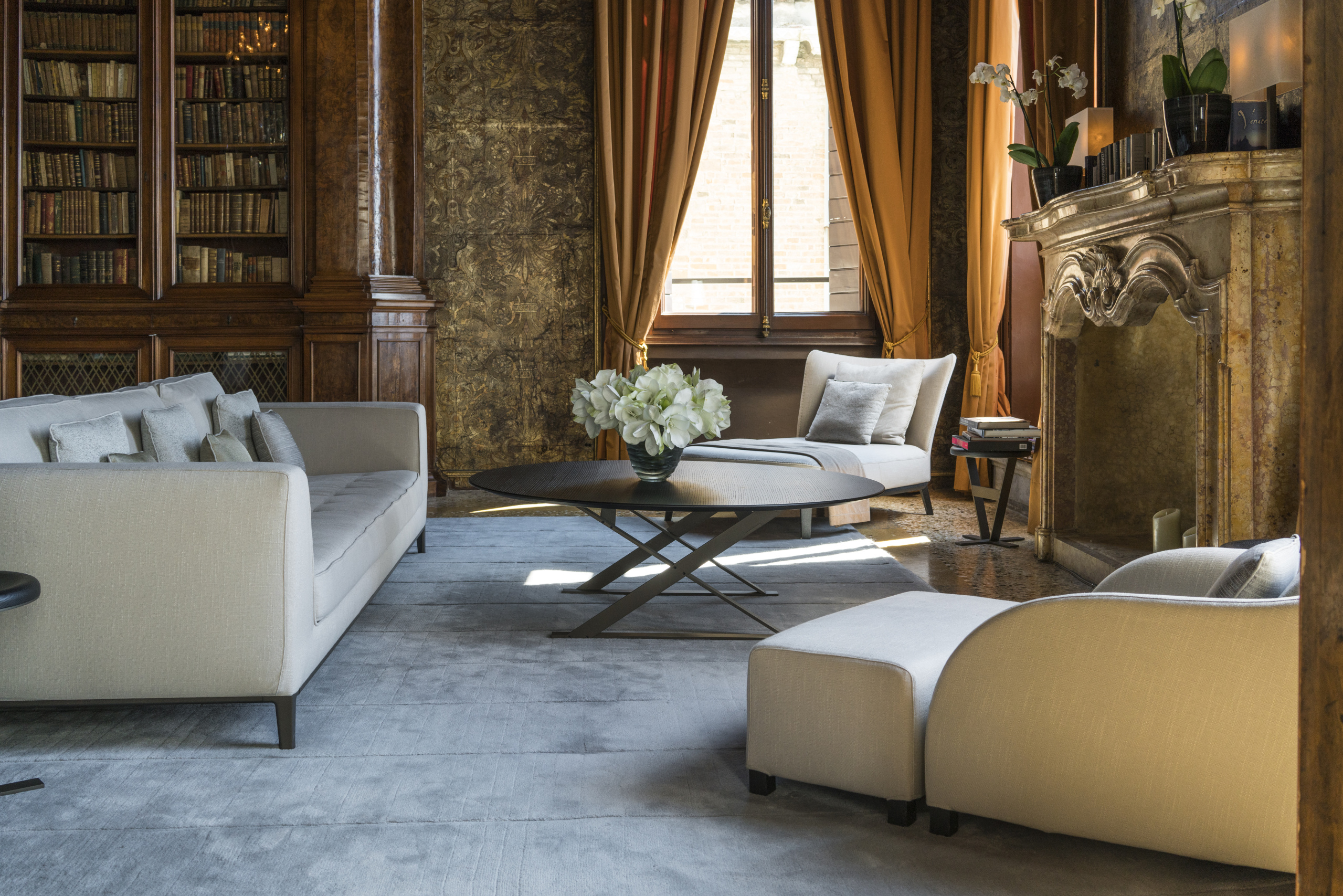
The historical uses of gold in East Asian art are not museum relics. They continue to inform how contemporary collectors and designers approach domestic space today. At Aman Nai Lert Bangkok, a 40-foot-high Chamchuri tree sculpture embellished in gold leaf anchors the lobby, creating what designer David Schoonbroodt [2] describes as an environment that exudes warmth and tranquility. In Venice, Aman's library features leather walls decorated with gold leaf, demonstrating how the material functions in intimate, contemplative spaces rather than just grand public ones.
|
|
|
| The Chamchuri tree sculpture within Aman Nai Lert Bangkok |
The Aman Venice Library |

Gold is then understood as active infrastructure within contemporary interiors. Japanese gold leaf wall art by Kanazawa artisans is now commissioned for living rooms, bedrooms, and office spaces, specifically because the texture of the gold leaf shifts with changes in light, making it versatile for personal environments.
For collectors in Singapore and across Southeast Asia, this translates into practical acquisitions. Contemporary artists working with gold are producing work that functions within modern homes the same way gold screens functioned in Momoyama castles: altering the quality of light, creating atmospheric depth, and establishing presence without dominating space.
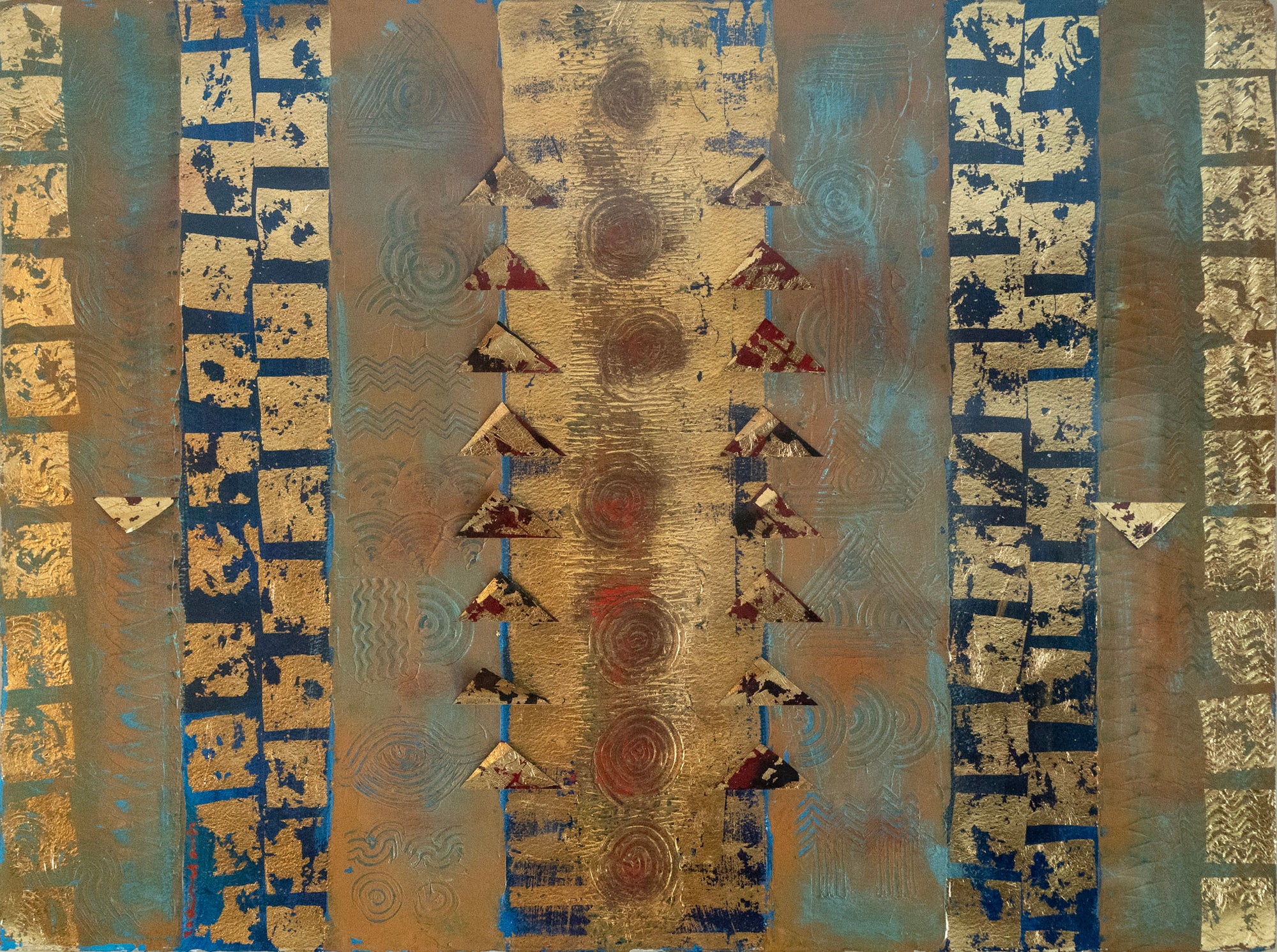
Artists like Teng Nee Cheong [3] and Tung Yue Nang [4] exemplify this contemporary approach. Teng's works incorporate gold leaf to create surfaces that catch and redistribute natural light throughout the day, while Tung's abstract compositions use gold leaf to establish fields that respond to their environment. These are structural decisions about how a work will perform within domestic space.
 |

|
| Tung Yue Nang, Gold Leaf II | Teng Nee Cheong, Entrancing the October Moon |
Keiko Moriuchi: Gold as Cosmic Structure
This past Singapore Art Week, Art Again presented Japanese artist Keiko Moriuchi's first solo exhibition in Southeast Asia at TOKONOMA. The show, titled Motif, featured works that demonstrated how gold leaf can function as more than decoration.
In Moriuchi's work, 24K gold leaf becomes what she calls 'The Universe's Prescription'. She integrates gold directly into the structure of the painting. The work changes depending on where you look at it, how you look at it, and when you look at it. Morning light reads differently from afternoon light, and the flaky nature of the work makes the surface feel kinetic.
Moriuchi was the last artist personally invited to join the Gutai Art Association [5]. Her practice unites sacred geometries, mythological symbols, and mathematical principles. Recurring motifs like the peach, the dragon, and angelic forms reference Buddhist ideals and ancient Japanese myths.
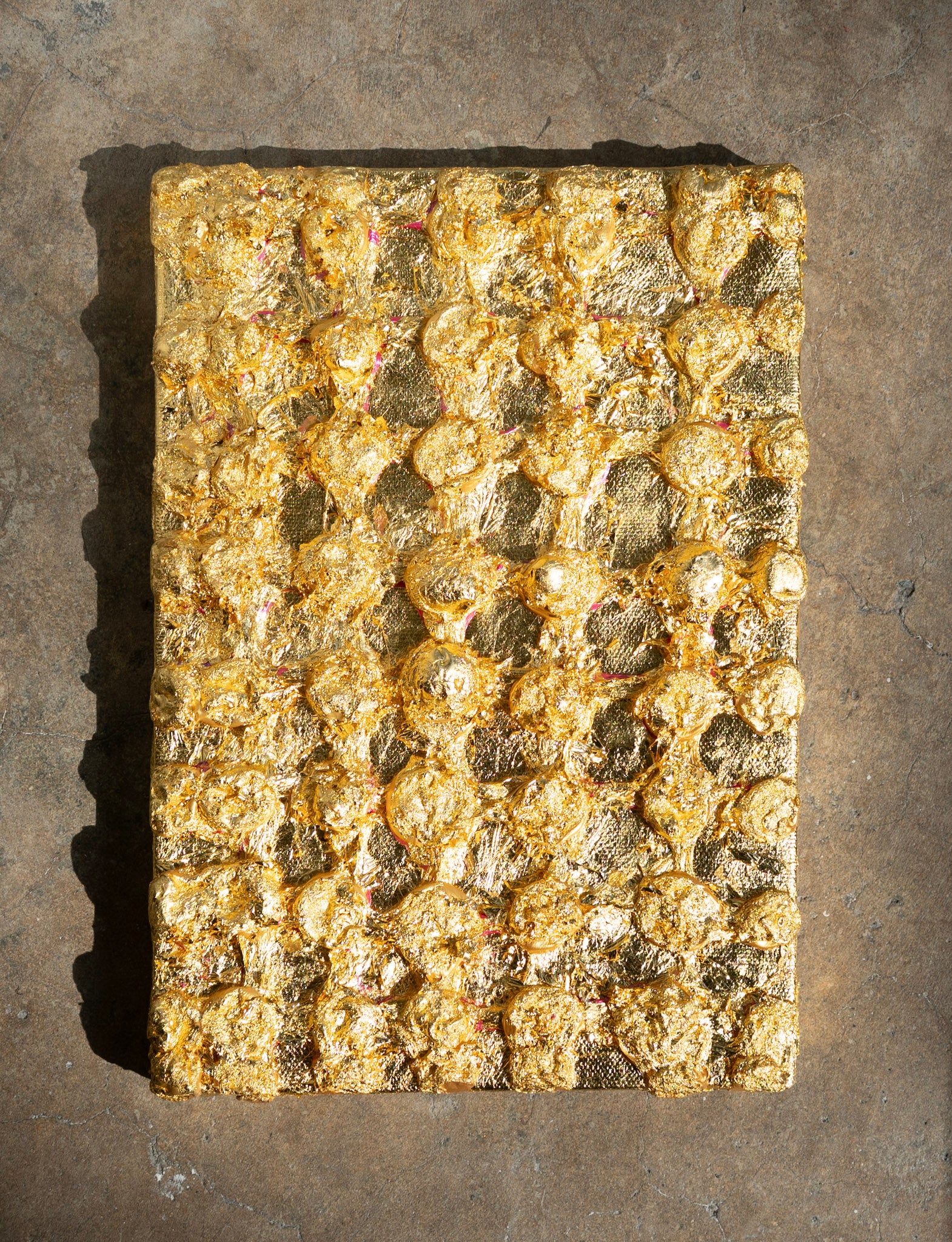
Keiko Moriuchi, The Forefront of the Never-Ending Thread II, 2025
Moriuchi's works are a contemporary entry point into the lineage of gold in East Asian art, acting as active participants in an ongoing conversation about material, light, and meaning. On display, the gold catches morning light differently than afternoon light. The surface shifts as you move around it. The work becomes part of the rhythm of the space, not a static object but an active presence.

Art Again offers works by Keiko Moriuchi. Only three more works are available; to see them, click through the pricelist on our site.
Huat Through Heritage
As the Year of the Fire Horse begins, the choice to bring gold into your home carries weight beyond decoration. Keiko Moriuchi's works sit at the convergence of Japanese Buddhist aesthetics, Gutai's experimental materiality, and the broader East Asian tradition of using gold to structure sacred and domestic space.
The question for the new year is about what kind of presence you want to cultivate in your space. If that understanding includes transformation and the capacity to hold centuries of cultural meaning in a single surface, then works incorporating gold leaf offer exactly that.

---
The Year of the Fire Horse is an opportune moment to reassess what occupies your walls. Aside from the three works by Keiko Moriuchi still available for sale, Art Again is having a Hu(Art) sale featuring over 200 works at up to 60% off, making it possible to bring meaningful art into your home without the usual barriers. Both regional modernists and contemporary practitioners are all available at reduced prices this season.
Now through 28 February 2026.
View the full collection here: https://artagain.co/collections/hu-art
--
Footnotes
[1] Momoyama period: A period in Japanese history (1573–1603) characterized by bold artistic expression, particularly the use of gold leaf in screen paintings and castle architecture. The era marked the transition from medieval to early modern Japan under military leaders like Toyotomi Hideyoshi.
[2] David Schoonbroodt: Belgian interior designer and creative director known for his work with Aman properties across Asia, emphasizing natural materials and regional craft traditions in luxury hospitality spaces.
[3] Teng Nee Cheong (1911–1990): Singaporean artist and key figure in the Nanyang Style movement, known for still life paintings blending Chinese ink traditions with Western techniques. He taught at the Nanyang Academy of Fine Arts.
[4] Tung Yue Nang (1938–): Malaysian-born artist based in Singapore, recognized for abstract compositions that bridge Chinese calligraphic traditions with modernist abstraction, often incorporating gold leaf and mixed media.
[5] Gutai: Japanese avant-garde art collective (1954–1972) founded by Jiro Yoshihara. The movement emphasized direct engagement with materials and process-based art, anticipating developments in performance, installation, and conceptual practice. "Gutai" translates to "concreteness" or "embodiment."
|
If you enjoyed this blogpost, consider buying me a coffee. Please scan the QR code here >> What is "buy me a coffee"? Buy Me a Coffee is a way for people to tip or say thank you to content creators and creatives. |
 |