


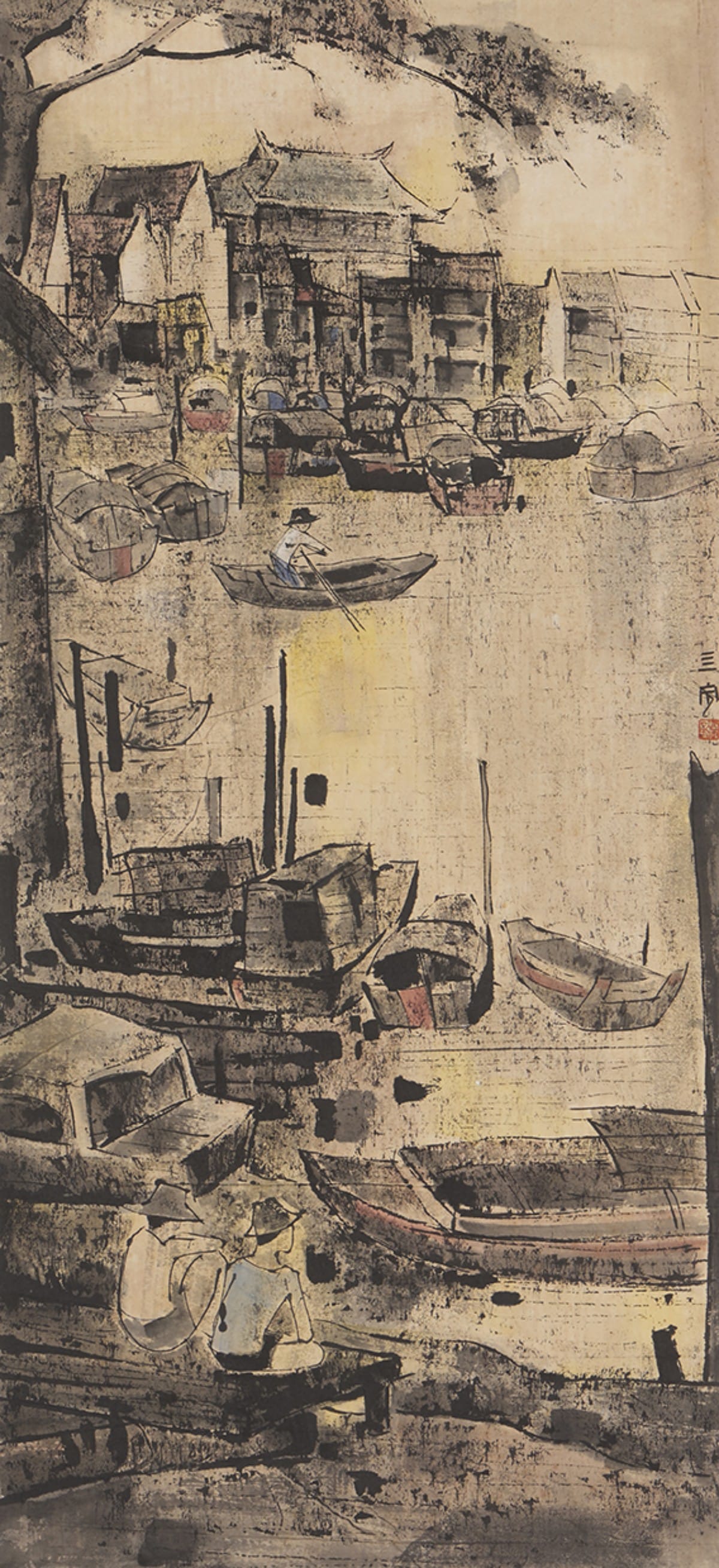
Cheong Soo Pieng, Houses on the Shore, 1961
Ink and gouache on paper
62 x 44 cm (unframed), 74 x 55 cm (framed)
Condition: Very good
Exhibition label from Frost & Reed Gallery, London, England, is affixed (on the verso)
Private Collection, England
Private Collection, Singapore
-
Cheong Soo Pieng arrived in Singapore in 1946 with training in both Chinese ink and Western painting, and became one of the founding voices of the Nanyang style, artists taking hold of a new home by painting it into being. His influence runs right through the Nauti exhibition: he taught many of the artists here, often out in the open along the river and the coast, demonstrating and then setting his students loose on the same scenes.
Houses on the Shore (1961) sits squarely in that project, a coastal fishing village rendered with the graphic clarity and muted palette that made these waterways such a durable subject for his generation. It is worth seeing beside Ng Eng Teng's kelong scene from the same years, the student and the teacher turning to the same disappearing coastline, and beside the fact that a Cheong river painting from this very year sits in the National Collection. Painted four years before independence, it is an early entry in what would become the era's most collected and exhibited theme.
The handling is distinctive, too. In his ink works on paper, Cheong typically used the multiple shifting viewpoints of the Chinese tradition, where the eye travels up and across the surface and no single standing point governs the scene, as in a comparable harbour work of the same year, now in the National Collection. Here he does the opposite. Cheong adopts a Western vanishing point: the boats and shophouses recede into a single, coherent depth, drawing the viewer to one fixed position looking in. The same subject, the same year, two entirely different ways of organising space.
Cheong Soo Pieng, "Singapore River", c. 1961. Chinese ink and colour on paper, 60 × 111 cm. Gift of Ministry of Culture. Collection of the National Gallery Singapore, courtesy of National Heritage Board.
-
Under the generous patronage of Singapore cinema magnate Dato Loke Wan Tho, Cheong Soo Pieng resigned from his post as teacher at the Nanyang Academy of Fine Art (NAFA) in Singapore, and embarked on a two-year-long sojourn in Europe from late 1961 to 1963. The trip was a turning point in Cheong's artistic career - with a move toward abstraction, and the eventual development of his own characteristic style of abstract expressionism with Chinese aesthetics.
Whilst in Europe, Cheong held three solo exhibitions - Frost & Reed Gallery in London, Galerie Schoninger in Munich, and Redfern Gallery in London. The works produced during this European period remain some of the most sought-after works from his entire artistic career. Houses on the Shore presents us with the opportunity of surveying Cheong's remarkable range of artistic production during his time in Europe.
-
Cheong Soo Pieng (Singaporean, 1917–1983) was one of Singapore's most influential modern artists and a pioneering figure of the Nanyang style. Born in Xiamen, China, he received formal training at the Xiamen Academy of Fine Arts and the Xinhua Academy of Fine Arts in Shanghai before settling in Singapore in 1946, where he taught at the Nanyang Academy of Fine Arts. Throughout his career, he developed a distinctive artistic language that synthesised Chinese ink traditions, Western modernism, and the landscapes and cultures of Southeast Asia.
Renowned for his continual experimentation, Cheong worked across oil, ink, watercolour, collage, batik, and mixed media, producing works that ranged from representational scenes to increasingly abstract compositions. His iconic depictions of elongated Southeast Asian figures became a defining feature of his mature style, reflecting his innovative approach to form and identity. Widely recognised as a leading pioneer of Singaporean modern art, his work has had a lasting influence on generations of artists and remains central to the history of the Nanyang movement.
(Photographed in May 2026)