Seen from Next Door: How Artists Painted Indian Life in Singapore
When Naraina Pillai [1] arrived in Singapore from Penang in May 1819, he became the first recorded Tamil immigrant to set foot on the island. Initially employed as a clerk in the colonial treasury, he went on to establish Singapore’s first brick kiln and a successful cotton business.
Raffles' initial party had included 120 Indian sepoys and a contingent of washermen and servants, some of whom stayed on. Tamil Muslim traders followed, and Indian convicts made up much of the labour behind the settlement’s early roads and public buildings. [2] The Indian community in Singapore consists of Tamils, Telugus, Malayalis, Punjabis, Bengalis and others, each with their own languages and traditions. [3]
 Naraina Pillai |
|

More than two centuries later, Indian culture continues to shape the city’s streets and public life, most visibly each Deepavali, when Little India and Jalan Besar alive with elaborate light installations and decorations. [4]
Over the decades, artists from outside the Indian community have also turned their attention to its temples, religious processions, workers and everyday life. What did they see in these subjects, and how did they find a place within their own understanding of Singapore?
A Temple in Chinatown
One of Pillai’s most lasting contributions was Sri Mariamman Temple. Founded by him in 1827 for worshippers from South India, it has shared South Bridge Road since 1835 with Masjid Jamae, a mosque built by the Tamil Muslim community [5]. Two South Indian communities of different faiths, with a Chinese neighbourhood around them, make the street a small picture of how Singapore’s communities settled alongside one another since her earlier days. 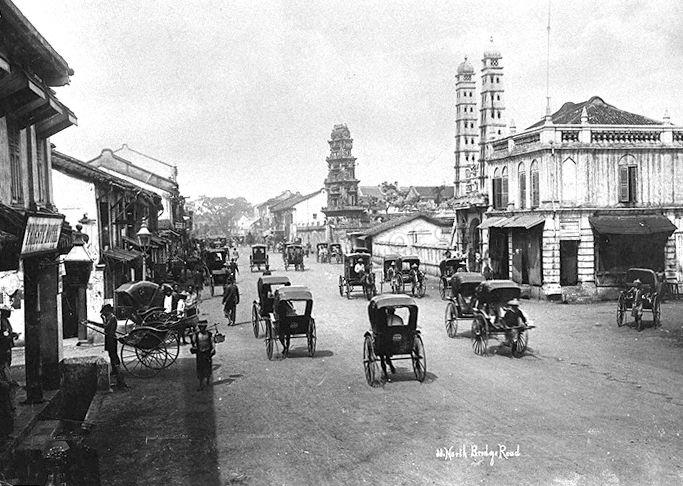
South Bridge Road, with Masjid Jamae and the gate-tower of the Sri Mariamman Temple
For Lim Tze Peng [6], who spent decades painting the neighbourhood’s streets, the temple was part of a familiar landscape. In Singapore’s Chinatown, a temple built for South Indian worshippers sits as naturally as the shophouses around it, a reminder that the neighbourhood, despite its very name, was never the preserve of one community. The temple has stayed distinctly Indian in its worship and festivals, and it is also, without contradiction, part of what Chinatown is.
Seah Kim Joo also painted Sri Mariamman Temple in batik during the 1970s. [7] The choice of medium is interesting in itself. With its roots in Southeast Asian textile traditions, batik places the depiction within a regional visual language, bringing together an Indian place of worship and an artistic medium associated with the wider region.
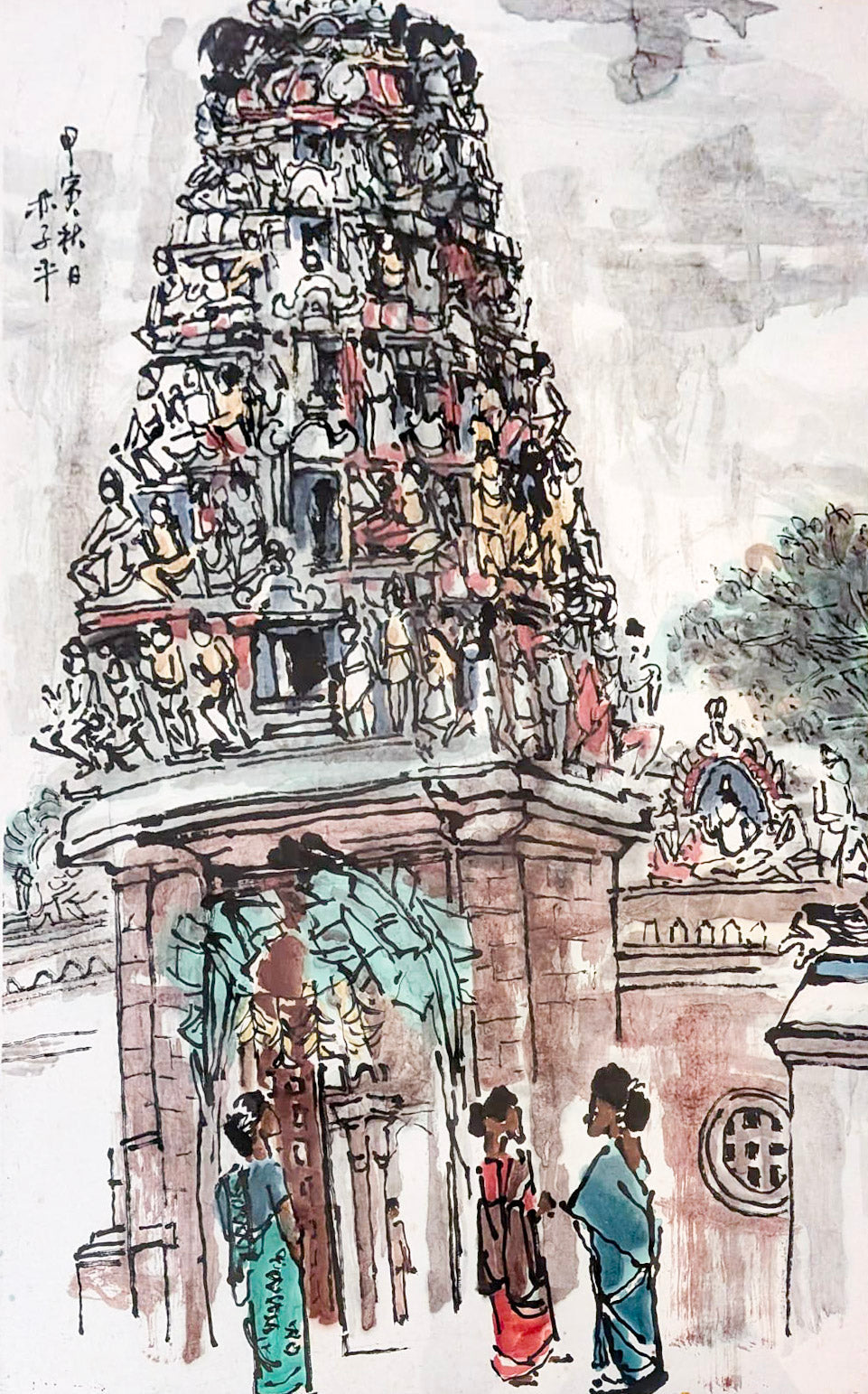 |
Lim Tze Peng, Sri Mariamman Temple (Singapore), 1974 View the artwork |
Processions and Public Ritual

Hindu Devotees for Theemithi at Sri Mariamman Temple
Religious life is also expressed beyond the temple grounds. Theemithi, Singapore’s annual firewalking festival in honour of the Hindu goddess Draupadi, has been held at Sri Mariamman Temple since 1840. Introduced by a community of caulkers from the Cuddalore region of South India, the ceremony takes place around a week before Deepavali [8]. Before the firewalk, a procession makes its way from Sri Srinivasa Perumal Temple in Little India to Sri Mariamman Temple in Chinatown. The traditions that migrants brought with them over time became part of the life of the whole city.

|
Aw Tee Hong, Elephants Adorned for the Procession, 2003 View the artwork |
Aw Tee Hong’s elephant procession takes us somewhere else. Aw travelled to India and painted scenes there [9], and this one is full of movement: elephants draped in orange and blue, with the crowd pressing close around them. Aw captures well enough the spirit of the procession, and you can almost hear the drums. Aw, who was raised in Malaysia and made Singapore his home, would have known Indian festivals first as they were celebrated here, before seeing them where they began.
The Workers Behind the City
Indian workers have been part of the city’s working history from the start, alongside workers from every other community: washing, building, hauling and clearing, often side by side. The party that landed with Raffles in 1819 included washermen and servants, and until 1873, Indian convicts did much of the work of laying the early settlement’s roads and public buildings [10]. Many returned home after a few years; others stayed, and their descendants are part of Singapore’s Indian community today. Much of that early work has since disappeared from view as the city changed around it.


King George and Queen Elizabeth, 1937
Some of it survives only in a name. Dhoby Ghaut, a part of the city now best known for our (dear) Plaza Singapura, takes its name from the dhobis, Indian washermen who once washed the city’s linen in a stream that ran through the area, and ghaut, the steps leading down to the water. The stream now runs underground, and the work has long gone, but the name is spoken every day by people who may never have heard of the dhobis. [11]
Chen Cheng Mei’s depiction of Indian workers at Dhoby Ghaut offers a glimpse of this earlier working life. Over several decades Chen had returned to India at least eight times. She sketched and photographed as she went, and back in Singapore she turned the same attention to the people and places around her during a period of rapid change. Having seen so much of India, she may well have recognised something familiar in the workers at Dhoby Ghaut. What runs through her work, at home or abroad, is an affinity for everyday scenes and the people in them. She described her aim as revealing “the myriad colours and lives” of the places she visited. [12]
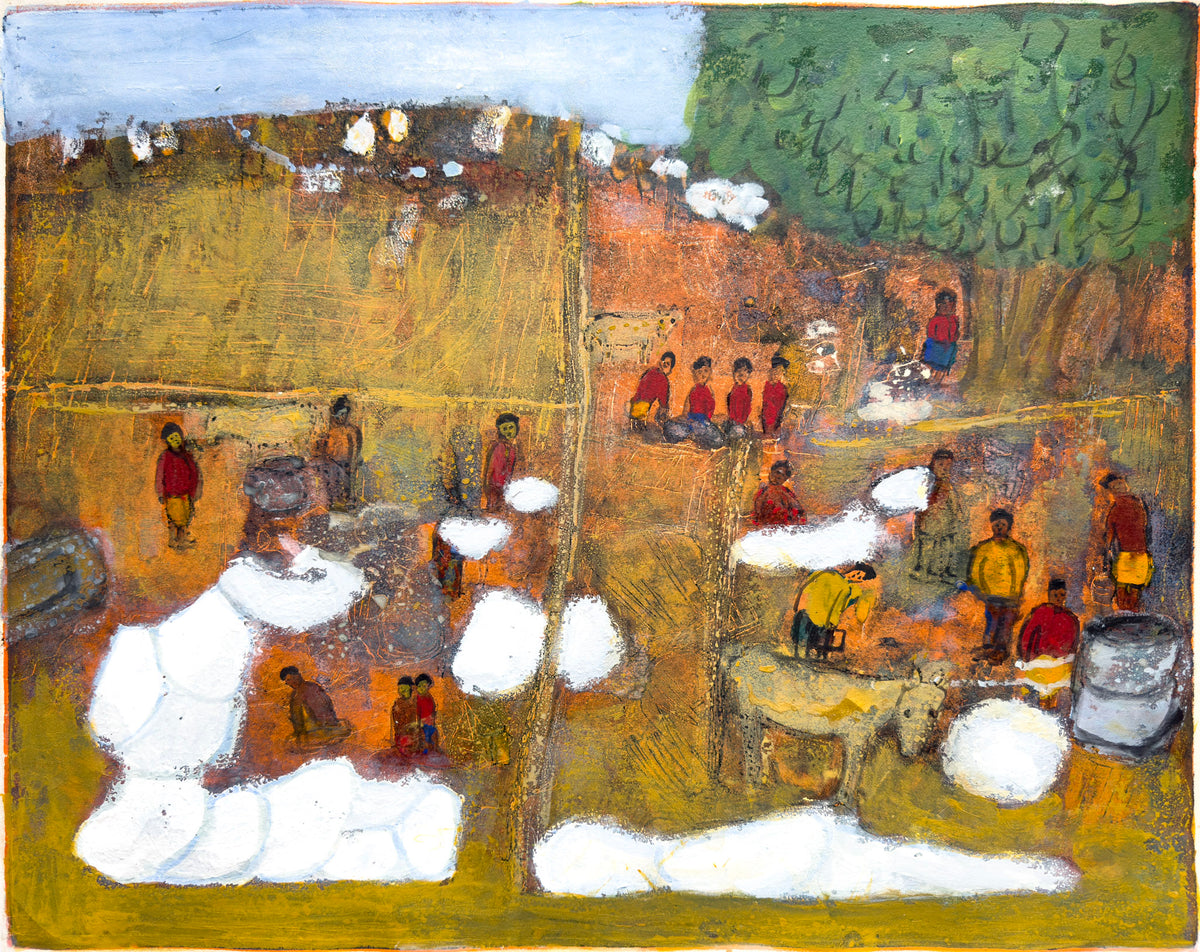 |
Chen Cheng Mei, Dhoby Ghaut (Orange), 1990s View the artwork |
Lim Hak Tai, founding principal of the Nanyang Academy of Fine Arts, painted Indian labourers in Indian Workers Clearing the Jungle (1955). Lim, who came from Xiamen, believed that art should carry a sense of localness, and his painting places Indian workers within the physical development of Singapore, acknowledging the labour involved in transforming its landscape. [13]

That work has not stopped. As Singapore has grown, workers from India have continued to come and build it, making up most of the construction and marine workforce [14]. On Sundays, tens of thousands of South Asian workers, come to Little India, sharing its streets with Singaporean Indians whose families arrived generations earlier. The towers, train lines and housing that define Singapore today rest on the labour of both. [15]
Dress and Everyday Life
In the late 19th century, Singapore’s leading photography studio, G.R. Lambert & Co., sold photographs of the island’s residents, listed in its catalogue as “types” at 25 cents a print [16]. Looking at them today, the labels matter less than what the camera caught along the way: how people dressed, the jewellery they wore, the objects they carried, the way they sat for the photographer. These everyday details, never the point of the picture, have become some of its most valuable parts.
 |

|

|

|
Painters often pick up on the same kind of ordinary detail. In Aw Tee Hong's Portrait of a Woman in a Sari, the woman sits, her eyes downcast. Adorning her is a bright yellow-and-red sari, with the draping coloured black with gold or yellow adornments. She looks dressed for a festivity, almost royal in an ordinary way. Her hair is long, and kept, and her gold bangles dangle from her wrist. It's a personal portrait that showcases the every day person. A preservation of the mundane every day.

|
Aw Tee Hong, Portrait of a Woman In a Red Sari, Undated View the Artwork |
Who Is Doing the Looking?
There is another dimension to these paintings worth considering: the backgrounds of the artists themselves.
Aw Tee Hong was born in Hainan and grew up in Malaysia before settling in Singapore. Lim Hak Tai came from Xiamen. Lim Tze Peng and Chen Cheng Mei were born in Singapore, in a city still being shaped by new arrivals. Like the Indian community itself, these artists belonged to a society made by migration. They painted Indian life less as hosts observing newcomers than as neighbours who had each, in their own way, made the same city home.
The works discussed here should be seen in that light. They are the perspectives of artists who chose to look closely at Indian life, not a full account of the lives they depict. Indian subjects have also received less attention than other familiar themes in Singapore art history, and these works are a reminder of how much of that history is still waiting to be looked at.
This Deepavali, we wish those celebrating a happy and meaningful festival.
Footnootes
[1] Naraina Pillai, the first recorded Tamil immigrant to Singapore. Formerly a government clerk in Penang, he arrived with Stamford Raffles in May 1819, took a temporary role at the colonial treasury, then set up Singapore’s first brickworks and a textile shop on Cross Street. In 1823 he was granted a site on South Bridge Road for a Hindu shrine, completed in 1827. National Heritage Board, Roots: “Naraina Pillai”
[2] When Raffles and William Farquhar landed in January 1819, their party included 120 sepoys of the Bengal Native Infantry and a contingent that included washermen and servants. National Library Board, Infopedia: “Sepoys”. On those who stayed on and the Tamil Muslim traders who followed, see Rajesh Rai, Indians in Singapore, 1819–1945: Diaspora in the Colonial Port City, Oxford University Press, 2014 (review in SOJOURN, ISEAS). On convict labour, see National Library Board, Infopedia: “Indian convicts”.
[3] The Singapore Department of Statistics defines “Indian” as persons of Indian, Pakistani, Bangladeshi or Sri Lankan origin, including Tamils, Telugus, Malayalis, Punjabis, Bengalis and Sinhalese. Cited in Wikipedia: “Indian Singaporeans”.
[4] Deepavali has been a public holiday in Singapore since 1929, and the Little India light-up along Serangoon Road is an annual part of the celebrations. National Heritage Board, Roots: “Deepavali” (Intangible Cultural Heritage)
[5] Sri Mariamman Temple, Singapore’s oldest Hindu temple, was gazetted a national monument in 1973. Its present structure was built in the early 1860s by artisans from the Cuddalore and Nagapattinam districts of South India. National Heritage Board, Roots: “Naraina Pillai”. On Masjid Jamae, built in 1835 by the Tamil Muslim community, see BiblioAsia, vol. 15, issue 3.
[6] Lim Tze Peng (1921–2025), Singapore ink painter and calligrapher, best known for his paintings of old Singapore, particularly Malay kampongs, Chinatown and the Singapore River. He received the Cultural Medallion in 2003. Esplanade Offstage: “Lim Tze Peng”
[7] Seah Kim Joo (b. 1939), born in Singapore and raised in Terengganu, where he learnt traditional batik-making. He studied at the Nanyang Academy of Fine Arts from 1959 and is best known for Malayan Life (1968), a five-panel batik. Ilham Gallery. His Sri Mariamman Temple – Chinatown Singapore (1970s) is recorded in a KL Lifestyle auction listing.
[8] National Heritage Board, Roots: “Theemithi” (Intangible Cultural Heritage). On the caulker community, see Roots; on its timing, BiblioAsia, Oct–Dec 2022.
[9] Aw Tee Hong (c. 1931–2021), born in Hainan, China, grew up in Malaysia before settling in Singapore. He graduated from the Nanyang Academy of Fine Arts in 1954 and the Central Academy of Arts & Design in Beijing in 1958, and is known for his paintings of the old Singapore River and public sculptures, including two at Raffles Place MRT Station. Sources give his birth year as 1931 or 1932. National Heritage Board, Roots; Wikipedia: “Aw Tee Hong”
[10] Between 1825 and 1872, Indian convicts made up the bulk of the labour force for public works in Singapore; the transportation of convicts to Singapore ceased in 1873. National Library Board, Infopedia: “Indian convicts”
[11] Must Share News: “S’pore Artist Reimagines Dhoby Ghaut From Colonial Times”. On the meaning of ghaut, see Penang Travel Tips: “Dhoby Ghaut”.
[12] Chen Cheng Mei (1927–2020), Singaporean painter and printmaker. She studied at the Nanyang Academy of Fine Arts under Lim Hak Tai and Cheong Soo Pieng, and was the woman behind the Ten Men Art Group. Quotation from Bonhams. On her travels, including at least eight trips to India, see AWARE: Archives of Women Artists and Wikipedia: “Chen Cheng Mei”.
[13] Lim Hak Tai (1893–1963), founding principal of the Nanyang Academy of Fine Arts in 1938. Indian Workers Clearing the Jungle, 1955, oil on board, Collection of National Gallery Singapore. National Gallery Singapore. On his belief in localness, see National Gallery Singapore: “Nanyang Reverie”.

[14] Work Permit holders from Bangladesh, China and India make up the majority of the workforce in Singapore’s construction and marine sectors. Singapore Management University
[15] Sunday is the most common weekly day off for South Asian transient workers in Singapore, the majority of whom work in construction. Tens of thousands visit Little India on Sunday evenings, most of them from Tamil Nadu. National Library Board, Infopedia
[16] Timothy Pwee, “Singapore in Sepia”, BiblioAsia, vol. 11, issue 4, 2016. BiblioAsia